

Recent Blog Posts
What Can a Father Do if His Wife is Abusive?
 It is generally more common for a man to abuse his wife than for a woman to abuse her husband, but there has been a recent rise in the number of women being arrested for domestic violence. This suggests that plenty of men experience abuse at the hands of their wives. Women who are violently abusive towards their husbands are also more likely to become violent toward their children. If you are a father seeking a divorce and your wife has abused you, you must be represented by an experienced Cook County, IL domestic violence and divorce attorney. Proving that your wife has been abusive and could be a danger to your children may be an uphill battle, but it is one that Cosley Law Office is willing and able to fight.
Gathering Proof of Domestic Violence or Abuse
Courts are sometimes, unfortunately, reluctant to believe men who say that their wives have battered them or harmed their children. Gathering as much evidence as possible is critical. Your attorney can give you specific advice for your situation, but some types of evidence you may want include:
What is the Right of First Refusal in Child Custody?
There will be occasions when the parent whose turn it is to spend time with the child needs someone else to watch the child. One parent might have an adults-only wedding to attend, a mandatory training outside of normal work hours, or an emergency to attend to. In these situations, parents who are still together would likely leave their child with a family member or hire a babysitter. When parents are divorced, it may not make sense to use a babysitter when there is a parent available to care for the child. This is where the right of first refusal comes in. Parents often agree to this term, as it generally benefits them both. An Arlington Heights, IL child custody attorney can help you plan for child care when the parent who would normally be with the child is not available.
How the Right of First Refusal Clause Works
When the right of first refusal clause is included in a parenting plan, it means that the parent who has the child with him must first offer the other parent the chance to spend time with the child before finding another babysitter. For example, suppose Parent A has parenting time for a week but needs to attend a funeral and does not want to bring the children. Parent A would be required to contact Parent B and offer her the chance to spend time with the children while Parent A is at the funeral. Only if Parent B refuses can Parent A make other arrangements for someone else to watch the children.
Newborn Drug Tests and Child Custody for Fathers
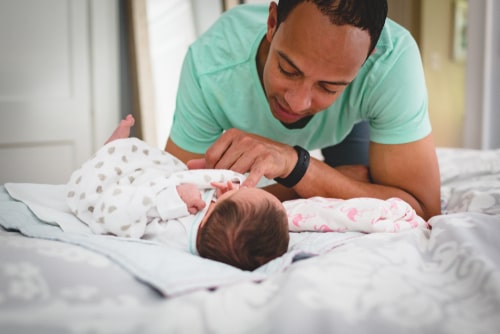 Finding out that the mother of your child has been using drugs during her pregnancy can be extremely alarming. No one wants to see their newborn child go through withdrawal or experience serious medical issues due to prenatal exposure to substances. It used to be the case that when a newborn baby failed a toxicology screen, the mother would immediately lose her parental rights and be reported to law enforcement. This enabled fathers to take exclusive custody. A new state law has removed these requirements. However, fathers who are seeking custody of their children can still argue that it is in the best interests of the child to stay with them during child custody proceedings. An experienced Rolling Meadows, IL fathers’ rights lawyer can help you.
What Does This New Law Mean for Fathers Seeking Custody?
Before this new law, fathers could almost automatically take full custody of babies born with drugs in their systems. Now, mothers who use drugs or alcohol during their pregnancies have the opportunity to try to prove that staying with them is in the baby’s best interests. Successfully making that argument may be extremely difficult for mothers until they have proven that they are genuinely committed to recovery.
When Your Ex's New Partner Is a Danger to Your Kids
 It is normal to feel apprehensive or distrustful when your co-parent starts dating someone new and bringing him or her around your children. Most parents want to get to know any adult who is spending a significant amount of time around their children. Not all adults are safe for children to be around. If you find out that the person your ex is dating poses a threat to your children, there are steps you can take to protect them. As soon as you have reason to believe that your ex’s new dating partner is not safe for your kids to spend time with, you need to talk to a Rolling Meadows, IL child custody attorney to find out what you can do to keep your children safe from him or her.
Steps You Can Take to Protect Your Children From Your Ex’s New Partner
Why you feel that your children are not safe around your ex’s new boyfriend or girlfriend matters. The more objective the reason and the more evidence you have, the more likely it is that the court will act quickly to ensure that your children are not exposed to the dangerous adult.
What Counts as Income for Child Support Purposes?
Child support is calculated based on the obligor’s income. The obligor is the parent who pays child support. To find out how much child support your child’s other parent owes, you will need to know how much money he makes. Some sources of income that are not taxable can be counted as income when calculating child support. Your child should not receive less financial support from a parent who has the means to pay more simply because he receives income or other payments that are not counted as income for tax purposes. The law considers your child’s other parent’s ability to pay based on all the money he has coming in each month. An Arlington Heights, IL child support lawyer can help you find out how much your child’s other parent owes.
Sources of Income That Count Toward Child Support
Your co-parent’s wages earned through employment are likely his main source of income. Income reported on a W-2 certainly counts as income when calculating child support, but there are many other possible sources of income that could count towards his child support obligations. Other sources of income include:
How Fathers' Rights Have Progressed
 Mothers used to be fairly heavily favored in child custody cases. This was in no small part because mothers used to be much less likely to work outside the home, meaning that many stayed home to serve as full-time parents. Now that most households rely on the income of two parents, fathers are becoming much more involved in caring for their children. Childcare duties are frequently split evenly between mothers and fathers - as are household expenses. This puts mothers and fathers on a more level playing field in child custody decisions. Illinois child custody factors that traditionally came out in favor of the mother are now just as likely to favor the father. Fathers in need of a parenting plan should always be represented by an experienced Rolling Meadows, IL child custody lawyer.
How Illinois Child Custody Factors Affect Fathers
Illinois judges consider a list of factors when making parenting time decisions. All factors apply equally to both parents, regardless of gender. Some of the factors that traditionally favor mothers, but are now just as likely to favor fathers, include:
Understanding Dissipation of Marital Assets
 Dissipation of marital assets is the legal term for when one spouse recklessly spends - or, more accurately, wastes - assets that belong to the marriage on something that benefits only himself without the consent of his spouse. Dissipating marital assets is more than being “bad with money” or making a few irresponsible or unnecessary purchases during the marriage. If your spouse dissipated marital assets, you are entitled to recover your fair share of the assets he wasted during the divorce process. Compensating one spouse for dissipated assets is part of the equitable distribution process in Illinois. Your Arlington Heights, IL divorce attorney can conduct a forensic financial analysis to determine whether your spouse’s misuse of marital funds amounts to dissipation.
What Is Not Dissipation of Marital Funds
It is generally not considered dissipation of marital assets on one spouse’s behalf if:
5 Ways to Get Divorced in Illinois
 You have many options for resolving your divorce. It is important to consult a Rolling Meadows, IL divorce attorney who can help you select the right method. Your options range from sitting down with your spouse and both of your lawyers to taking your case to trial. Which method is right for you depends on factors like how amicable your divorce is, whether your marriage involved any abuse, and how complex dividing your marital property equitably is likely to be. While most spouses who try to achieve an uncontested divorce succeed, proceeding to litigation is an option if you find that collaborative divorce or mediation is not working.
Your Divorce Resolution Options
Methods for getting divorced you can likely choose from include:
- Traditional mediation - In traditional mediation, both spouses and their respective attorneys sit down together with a mediator. The mediator guides the discussion while the attorneys provide guidance and keep you aware of your rights. This method tends to work well if you and your spouse are civil.
Who Keeps the Pets in an Illinois Divorce?
 As much as many “pet parents” would like their dogs, cats, and other animals to be regarded like their children during divorce, pets are considered property in Illinois. This means that they are subject to equitable division. The court will try to do what is fair to both spouses when it comes to determining who keeps the pets during a divorce. Our state’s equitable division laws give courts significant freedom to consider a number of factors in deciding what type of arrangement would be the most fair. Most judges will recognize the emotional attachment pet owners have to their furry family members and take this into consideration. Pet parents also have the option of working collaboratively to decide on a visitation plan or to determine who keeps the pets amongst themselves. A Rolling Meadows, IL divorce attorney can help protect your interest in the family pets.
Can I Move with My Children After My Illinois Divorce?
 Divorce is a new beginning. As your marriage concludes, your new life as a single and free adult begins. Wanting to move away from the place you lived with your spouse is normal and common. However, if you have minor children, bringing them with you when you move might complicate your divorce. If you are already divorced when you decide to relocate, you may need to modify your parenting plan. There are a lot of different factors to consider when you are relocating with children. The court will primarily be concerned with whether the move will be good for the child. You must also consider the logistics of helping your children consider their relationship with the other parent. An Arlington Heights, IL, child relocation attorney can guide your efforts at relocating and help you modify your parenting plan as needed.

Schedule Your Free Consultation
Arlington Heights Office 3030 Salt Creek Lane, Suite 120 Arlington Heights, IL 60005 Phone: 847-253-3100


At Cosley Law Office, we represent clients throughout Illinois, including Arlington Heights, Barrington, Buffalo Grove, Des Plaines, Elk Grove Village, Glenview, Hoffman Estates, Inverness, Long Grove, Mount Prospect, Mundelein, Northbrook, Palatine, Prospect Heights, Rolling Meadows, Schaumburg, Schiller Park, Wheeling, and Wood Dale, as well as Cook County, Lake County, DuPage County, and throughout the Chicago, IL metropolitan area.
Results listed are not a guarantee or indication of future case results.

© 2026 Cosley Law Office
3030 Salt Creek Lane, Suite 120, Arlington Heights, IL 60005
847-253-3100